

Fivoor

No VOG slips through the cracks
Fivoor is a forensic care organization, with clinics and outpatient teams spread across several regions of the Netherlands. Its employees work with vulnerable clients every day. That is why every new colleague has to submit a valid Certificate of Conduct (VOG).
That process is crucial, but also time-consuming. HR has to track, remind and follow up on new employees at many different locations. From head office, it isn't always clear who has started where. Together with VionA, Fivoor fully automated this process, so that no VOG slips through the cracks.
From chasing people manually to a process that monitors itself
HR used to keep track by hand of which new employees had not yet submitted their VOG. That meant lots of emails, lots of reminders and a lot of chasing colleagues across many locations. Important work, but also repetitive and time-consuming.
Now the automation takes this over completely. Every day it checks the list of new employees and looks at who hasn't submitted a VOG yet. At set moments in the first weeks after their start date, that employee automatically receives a reminder, tailored to the type of employee.
If the VOG still doesn't come in, the automation escalates step by step. At first the reminder goes only to the employee. Only if the VOG is still missing after a certain period are the manager and the HR advisor informed, and finally management. This way an outstanding VOG always reaches the right person in time, including at locations that head office has less visibility of.
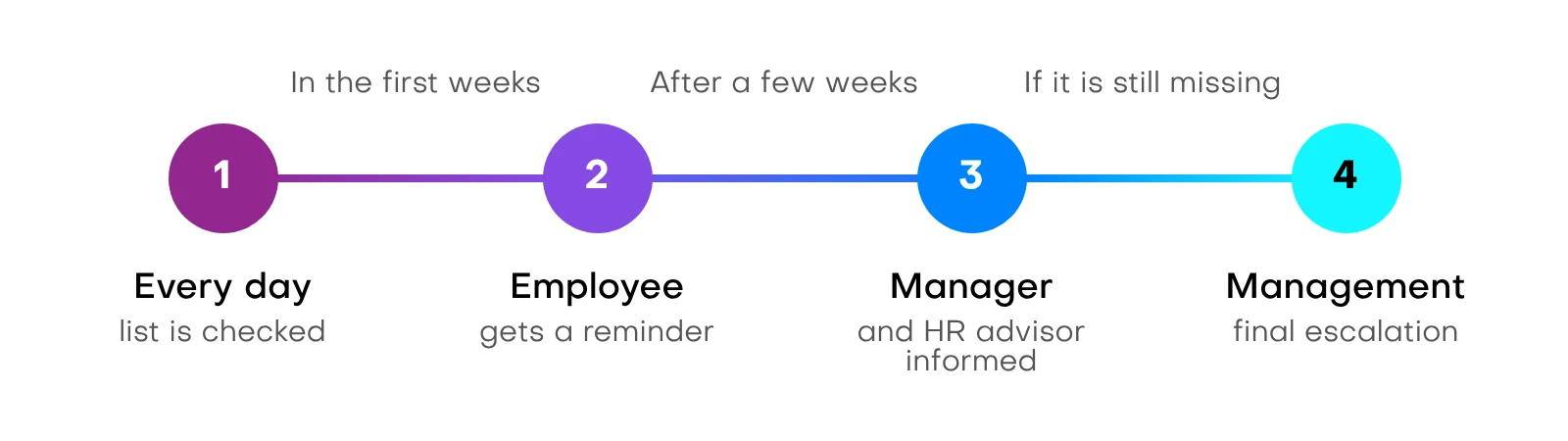
The result: HR no longer has to keep track of anything, and the ideal process is now carried out consistently for every new employee.
How the partnership makes this possible
In forensic care, trust isn't a nice-to-have, it's a requirement. That's why VionA set up the partnership entirely around Fivoor's requirements.
- A fixed, screened team. The VionA automation consultants who work for Fivoor have their own VOG-P and their own employee account at Fivoor. Only they build and support the automation, so Fivoor always knows exactly who is involved.
- Fivoor stays the owner. The automation runs on a service account owned by Fivoor itself, not on a VionA account or one employee's account. So everything keeps working, even when someone leaves.
- Secure access. Login details are stored separately and securely, in a shielded environment used only for Fivoor.
- Mapping the process together. Before anything is built, VionA maps the process together with HR. That way the automation works exactly the way HR would ideally want it to.
- Support after delivery. VionA monitors the automation and acts quickly when something changes in the environment.
Why not AI? The smartest choice is sometimes the simplest
Many organizations immediately think of AI when it comes to automation. For this process, VionA deliberately chose rule-based automation (RPA). Not because AI couldn't do it, but because it simply isn't needed here.
The data is clear and structured. All the information is in a SharePoint list with fixed fields. A start date is always a date in the same format, and for each employee it is recorded which email has already been sent. AI is strong when data is messy or ambiguous, such as free text or varying formats. That's not the case here.
The rules are crystal clear. Has someone been employed for two weeks, still without a VOG, and hasn't received a reminder yet? Then a reminder goes out. Every step is a fixed, predictable decision. That's exactly what RPA is made for.
Only the data that's really needed. The automation looks only at the fields needed for the reminders and does nothing with any other information. An AI model often reads more than necessary. That can be set up securely, but in a sensitive environment like forensic care the principle is simple: if you don't need it, you don't do it.
Predictable and explainable. Every decision the automation makes can be traced back to a fixed rule. That makes the process transparent for HR and easy to maintain.
If your data is structured and your rules are clear, RPA is often faster, cheaper and safer. If your input is messy, such as emails, documents or free text, AI adds real value.
Who is this relevant for?
- Care and welfare organizations that work with vulnerable groups and require a VOG: mental health care, disability care, youth care and elderly care.
- Organizations with many locations, where HR works centrally but new employees start locally.
- HR departments that spend a lot of time reminding, calling and following up.
- Organizations with sensitive data looking for automation with privacy, control and ownership properly arranged.
- Organizations torn between AI and RPA that want to know what fits their process best.
VOG reminders and escalations
HR manually tracked which new employees had not yet submitted their VOG (Certificate of Conduct). Someone had to go through the list, send reminders and involve managers when nothing came in: time-consuming work that was easy to forget. Now the automation checks all outstanding VOGs every day, so no new employee slips through the cracks.
- Reading the SharePoint list of new employees every day
- Deciding per employee whether a reminder is needed, and which one
- Sending the reminder automatically, tailored to the type of employee
- Escalating to the manager, HR advisor and management when needed