


Approach
Strategy
Strategy first, technology second
Automation rarely fails due to the technology itself, but often due to the lack of a prior plan. We reverse that order: first, we determine what AI and automation should deliver and whether the solution fits how your organization works. That involves more than just technology. That is why we examine your organization from four perspectives: what you want to achieve, within which frameworks, with which people, and in which processes. Only when those four align does a plan emerge that works in practice. And only then do we start building.
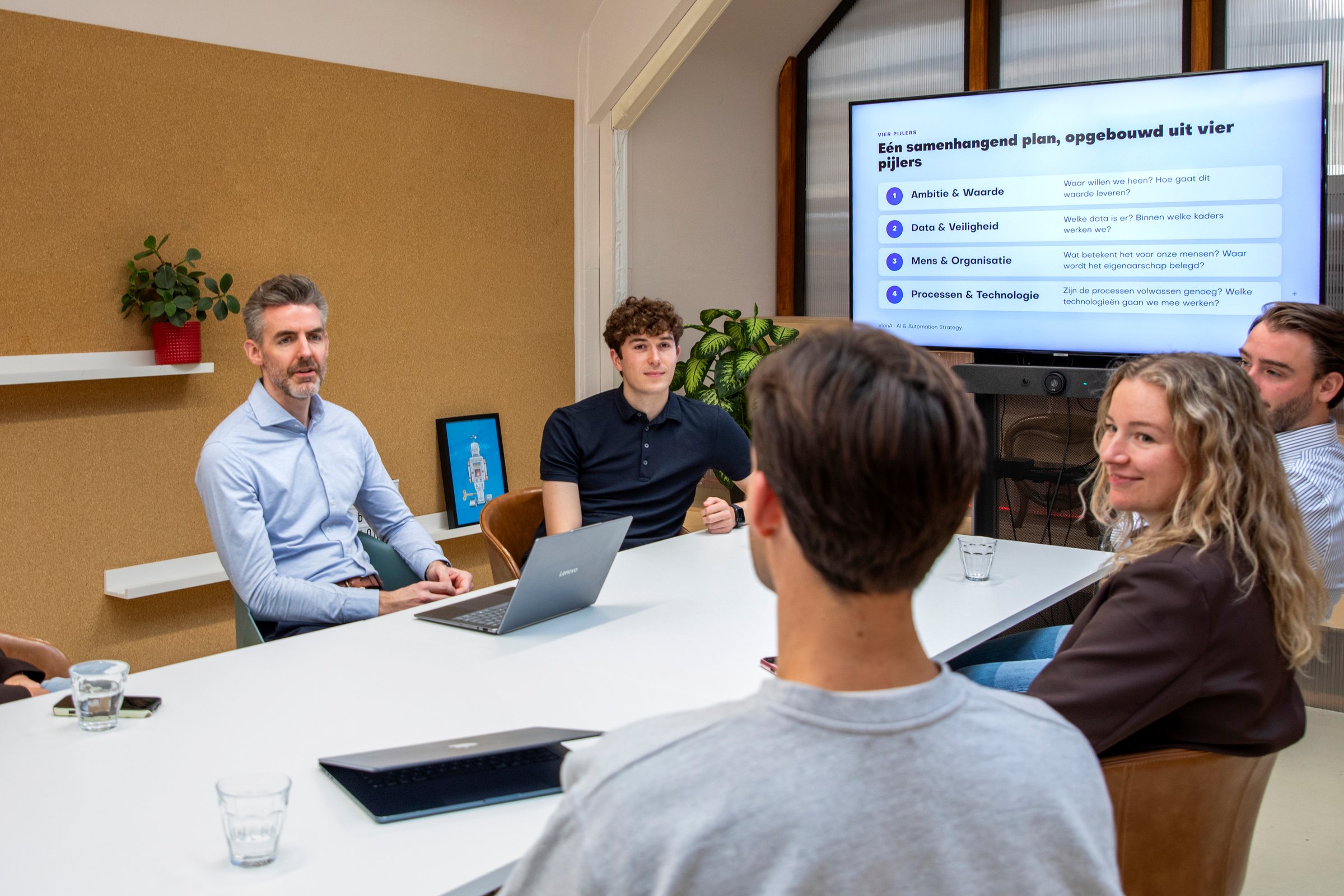
01 · Ambition & Value
Where do you want to be in a year?
Not every organization needs to be at the forefront of AI, but every organization needs to know which direction it is heading. Together with your management team or board, we determine how ambitious you want to be and link that ambition to what is already on the agenda: your business strategy, your KPIs, and what customers expect from you. Is it about lower costs, higher quality, greater speed, or room for growth? This creates a direction that the entire management team can support.
✓
An ambition statement and a chosen level of ambition

02 · Data & Security
Control over data and regulations
It is highly likely that colleagues are already using AI tools, sometimes with company data and without clear guidelines. We first examine what is already happening, what data you have, and which rules apply to you: the EU AI Act, the GDPR, and your industry's requirements. We then establish what is and isn't permitted, who owns the data, and who is responsible if something goes wrong.
✓
An AI usage policy and a data quality analysis
We work according to an ISO 27001-certified development process ourselves.
Read more about ISO 27001 here →
03 · People & Organization
AI only works if your people are on board
AI changes work, and that raises questions: which tasks will change, what do people need to learn, and who will take the lead? We map out what AI means for roles and tasks, and involve employees and the works council from the start. With an AI lead and ambassadors on the work floor, you place ownership within your own organization, so that the change feels like a relief rather than a threat.
✓
A change approach and a training plan for AI literacy
04 · Processes & Technology
Start where the gains are
Together with the people who do the work every day, we track down time-wasters and repetitive tasks. We examine your application landscape: which systems, integrations, and data are already in place. Following lean principles, we improve what can be improved first, and only then do we automate. For each opportunity, we weigh whether it is better to buy, build, or integrate, and we prioritize everything based on impact and effort.
✓
A list of quick wins, each with a savings calculation
Embedding
A strategy is only valuable if it is executed
That is why we sit down with you every quarter. We look back: what have the automations delivered, and what held us back? We share which new AI developments, tools, and regulations are relevant to you. And we check whether we are still on the right track. You leave with concrete actions, each with an owner and a deadline, and often with the next automation already in the works.
Results
Tech update
Course check
New actions
Curious about where the gains are in your organization?
These companies preceded you
Swipe or scroll right for more cases →

Featured
Staffing

5 years of automation at Luba
What started with a single automation has grown into a portfolio of six processes and a fixed quarterly cycle.
Read the growth journey →







View all case studies →
Read how other organizations have grown with VionA, from staffing to logistics.